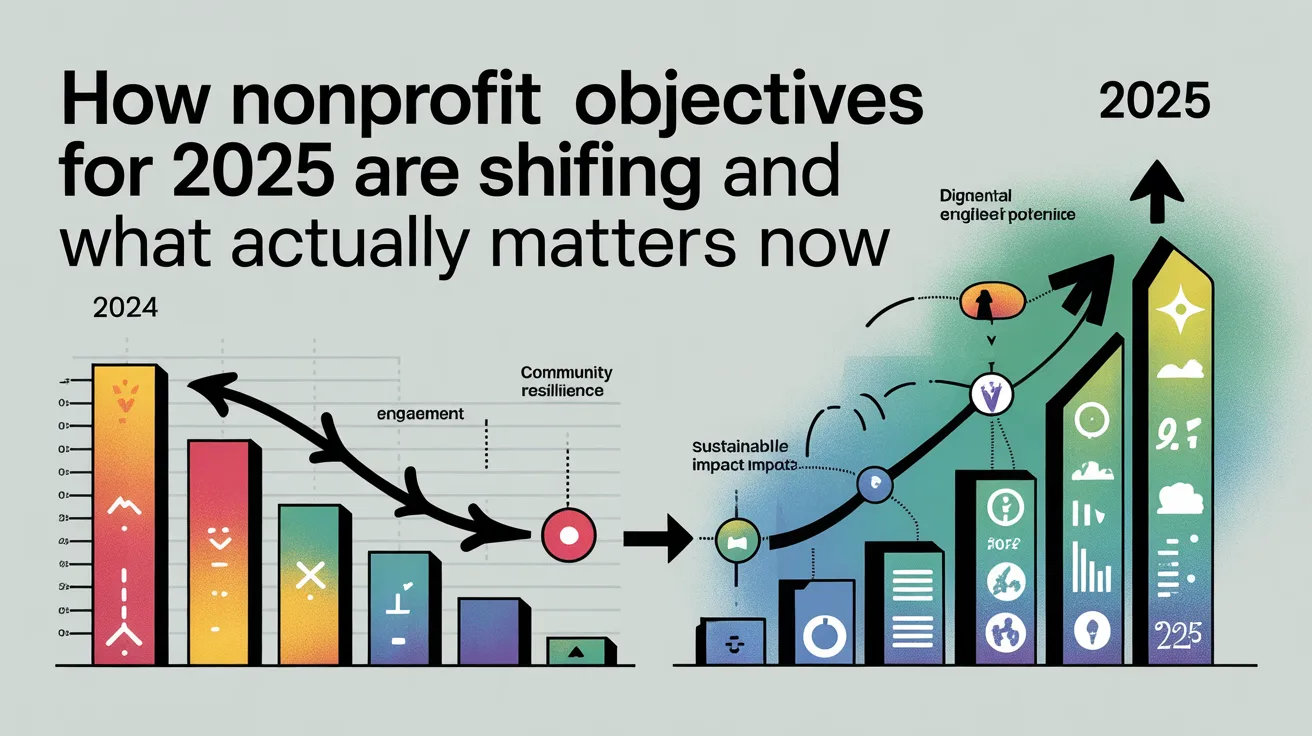
I thought that when I first began to none company objectives 2025 it would be the same old song: raise funds, create awareness, rinse, repeat. However, having read actual reports, case studies, and what operators are actually doing on the ground, my views changed. It is not merely growth any longer, but survival, sustainability, and quantifiable impact. And frankly, some of these changes are long overdue.
In 2025, nonprofit goals will be less about doing more and more but doing smarter.
- It is not the size that counts.
- Sustainability outdoes short-term funding.
- Digital presence is not an option anymore.
When an organization does not take these into consideration, it is already lagging behind.
What I Found out After Learning the Real Nonprofit Strategies of 2025.
The largest change I continued to observe was a change in the direction of not having general mission statements but having quantifiable results. Organizations are no longer identifying themselves as help communities; they are specifying the number of people they are reaching and the depth of their reach. Such clarity was not prevalent even several years ago.
The other interesting thing is the way nonprofits are thinking long-term. In the past, a lot of them were so dependent on donations and had no contingency plan. There is now a definite trend towards diversified revenue-generating things like social enterprises, partnerships, and recurring donor models. It is not as emotional; it is more strategic.
And the digital side. Virtually all of the successful nonprofits I researched had invested in online tools, be it donor management systems or social media outreach. It is no longer about visibility. It is all about effectiveness and monitoring outcomes.
The Real Objectives Nonprofits Are Working on Now.
In my opinion, these are the main goals defining 2025:
- Achievable social impact objectives.
- Financial sustainability models
- Strong digital infrastructure
- Transparent reporting systems
- Community-driven decision making
These are no longer nice-to-haves. None Company Objectives 2025
Advantages & Disadvantages Table
| Advantage (What Worked) | Disadvantage (What Frustrated) | My Honest Take |
|---|---|---|
| Clear impact measurement | Hard to track accurately | Necessary but complex |
| Diverse funding streams | Takes time to build | Worth the effort |
| Digital tools improve reach | Tech learning curve | Short-term pain |
| Data-driven decisions | Less flexibility | Balance is key |
| Community involvement | Slower decision-making | Builds trust |
Clarity is the greatest benefit. Everything is easier to handle when nonprofits set certain objectives, such as assisting 10,000 families rather than supporting communities. Teams remain on track, donors have more faith in the process and results become visible.
The other big victory is sustainability. Diversified organizations do not panic when a single source of funding runs dry. Such stability had not been the norm previously, and it is a game-changer.
Where It Frustrates.
However, everything is not smooth. The idea of impact measurement is wonderful, but in practice, it is a mess. It is not possible to measure everything, particularly social change over the long term.
Secondly, implementing digital tools may initially slow down teams. This is particularly a challenge to smaller nonprofits that do not necessarily have the resources or expertise to adopt systems on the fly.
✓ Why This Shift Matters.
✓ clearer goals
✓ smarter funding
✓ stronger trust
✓ long-term survival
What the Majority of People Misunderstand about Nonprofit Objectives.
One of the errors I continued to make is that I concentrated on fundraising. Money, of course,–but not the goal. It’s a tool. Organizations that view funding as the ultimate objective usually become lost.
The other misconception is to imitate large nonprofits. What is effective in a large international organization may not necessarily be effective in a small local NGO. Scale transforms all things, resources, expectations, and strategy.
Lastly, a lot continue to disregard data. Not that they do not care, but it is overwhelming. But evading it would cause greater problems in the future- particularly when donors begin posing more difficult questions.
The Real State of Nonprofits.
In my experience, the majority of organizations are operating hybrid models.
They combine:
- Conventional fundraising (events, donors)
- Online campaigns (social media, email)
- Information monitoring (KPIs, dashboards)
Reviews every week are becoming the norm. Teams are not just planning annually, but monthly or even weekly, depending on performance. Such a degree of flexibility is novel–and needed.
More careful attention is also being paid to costs. Productivity has become a goal, rather than an incidental consideration.
Who Must Not Blindly Fall in With These Trends.
When a nonprofit is very small, such as a volunteer-only organization, attempting to adopt complicated tracking systems or digital tools may end up slowing down the process. Then simplicity is more effective.
Moreover, those organizations that are so dependent on local trust and community relations should not over-digitize everything. Automation does not work with all audiences. At times, personal connection prevails.
Questions that People Ask.
What do the key goals of nonprofits in 2025 look like?
The emphasis is changing to measurable impact, financial sustainability, and transparency. No longer can it be just to do good; organizations are supposed to demonstrate outcomes with data and clear reporting.
What is the measure of success of NGOs today?
The majority of them are based on such KPIs as the number of beneficiaries, improvement (health, education), and cost efficiency. This is now monitored in real time using digital tools rather than annual summaries.
What are the trends influencing nonprofit strategies?
The largest trends are digital transformation, diversified funding, and data-driven decisions. There is also increased interest in community involvement in program development.
What will nonprofits need to do to remain sustainable in 2025?
By diversifying and minimizing reliance on one source of funds and creating recurring revenues. Social enterprise models are also being investigated by many as a way of generating steady income.
Do nonprofits need digital tools?
Yes—almost essential now. They are used to manage donors, monitor impact, and enhance outreach. In their absence, scaling is extremely challenging.
✓ What Makes a Strong 2025 Strategy
✓ data-backed decisions
✓ multiple income streams
✓ clear impact goals
✓ adaptive planning
Conclusion – The One Thing To Remember.
Having examined the way in which nonprofit goals are changing, one thing is apparent: clarity is better than ambition. The organizations that thrive in 2025 will not be the ones that attempt to do everything, but will be the ones that do a few things very well and demonstrate it.
When a nonprofit is able to quantify its impact, maintain its funding, and innovate fast, it stands a chance. Otherwise, even the good intentions will not suffice in the future.